
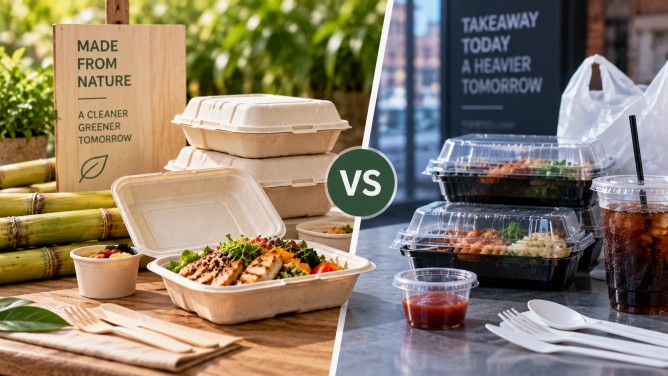
As businesses evaluate their packaging needs, both bagasse and plastic containers come with unique benefits tailored to specific food service requirements. The decision between the two hinges on various factors such as the menu type, the duration for which the food needs to be held, sealing needs, regulatory considerations, end-of-life disposal infrastructure, and the overall cost of packaging.
Bagasse containers are particularly advantageous for serving hot meals, rice dishes, pasta, catering trays, and meals that are divided into compartments. The molded-fiber composition of bagasse offers rigidity and an appealing presentation, while additional barrier options can enhance its resistance to grease and moisture, as well as improve its sealing and temperature retention capabilities. For those prioritizing compostability, bagasse is a viable option, provided the entire product, including coatings, laminations, inks, adhesives, and lids, is assessed as a complete system. The presence of appropriate collection and composting facilities in the target market further influences its practicality.
Plastic containers, on the other hand, remain valuable for cold foods, items that require clear visibility, high-moisture foods, and cost-sensitive programs where local waste management systems can accommodate the selected polymer. Rather than defaulting to one material over the other, businesses should compare specific plastic products against suitable bagasse alternatives. A strategic, gradual transition may often be more feasible than a wholesale switch from plastic to bagasse containers.
Different types of food require different container structures. Meals that are hot, oily, or heavy in sauce should be tested for deformation, leakage, grease resistance, and lid compatibility during the actual holding period. Fried foods need evaluations for condensation, ventilation, and the retention of food texture, while soups and liquid-rich dishes require a comprehensive assessment of the container-and-lid system. Delivery programs also necessitate testing for stack stability and transport durability using actual meal weights and delivery times. For microwave or reheating applications, only containers validated for the specific temperature and heating method should be used.
Standard bagasse products differ significantly from those that are coated or laminated, with added barrier systems enhancing oil and moisture resistance, sealing, and temperature performance. Laminated bagasse may incorporate materials like PLA, PET, CPET, or EVOH, depending on the application, and these should not be presumed to have the same compostability or recycling potential as unlaminated products. While bagasse containers may have a higher initial purchase price compared to conventional plastic alternatives, the overall cost is influenced by other factors such as carton quantities, freight efficiency, storage needs, lid compatibility, and disposal costs. Conducting a controlled pilot with high-volume menu items can provide a clearer economic comparison. Grizzlies Industries, with its extensive manufacturing capabilities, offers OEM/ODM solutions to support businesses looking to transition to molded-fiber packaging, providing custom options tailored to specific requirements.
Legal Disclaimer:
The information contained in this article has been provided by independent third-party contributors, clients, or content partners. We do not independently verify the accuracy, completeness, legality, ownership, licensing, or reliability of submitted content, including text, images, videos, trademarks, or other media materials. The submitting party is solely responsible for ensuring that all content, including images and media assets, complies with applicable copyright, trademark, licensing, and intellectual property laws. We disclaim liability for any unauthorized use of copyrighted or proprietary materials by third parties. If you believe that any content published on this platform infringes your intellectual property rights, kindly contact the author above for prompt review and resolution.