
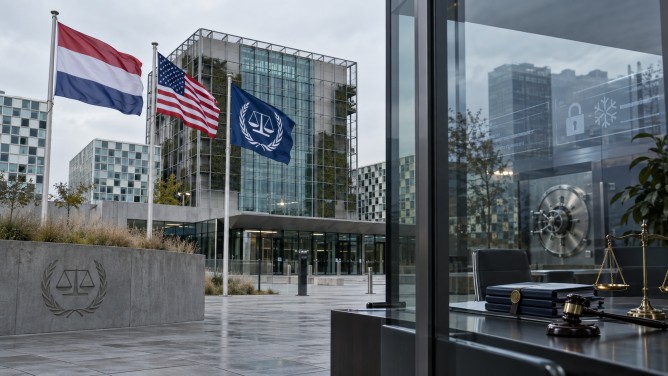
The ongoing clash between the United States and the International Criminal Court (ICC) has prompted the Netherlands to brace for potential new sanctions from Washington. These punitive measures could severely impact the operations of the ICC, which is headquartered in The Hague, and the Dutch government is considering steps to help the tribunal sustain its essential activities.
The Trump administration has already targeted several ICC officials with sanctions, citing objections to the court’s investigations involving U.S. and Israeli personnel. Washington claims the ICC has overstepped its jurisdiction, leading to strained relations. Now, the possibility of extending sanctions from individuals to the ICC as an institution looms, which could disrupt its access to U.S. financial and technological services.
In response to this threat, the Netherlands is exploring ways to ensure that the ICC can continue its work, such as securing funding for staff salaries, witness protection, and maintaining detention facilities. As the host country, the Netherlands has previously engaged in discussions to mitigate the impact of any U.S. sanctions on the court’s operations.
The ICC is preparing for potential restrictions by repositioning some of its services away from American providers and reassessing its financial and technological dependencies. This strategic shift aims to safeguard the ICC’s capacity to prosecute individuals accused of genocide, war crimes, crimes against humanity, and aggression, especially in situations where national courts are unable or unwilling to act.
Established in 2002, the ICC plays a crucial role in international justice by holding perpetrators of the world’s gravest crimes accountable. As tensions with the U.S. escalate, the Netherlands’ support becomes increasingly vital to the court’s mission and its ability to uphold international law.