
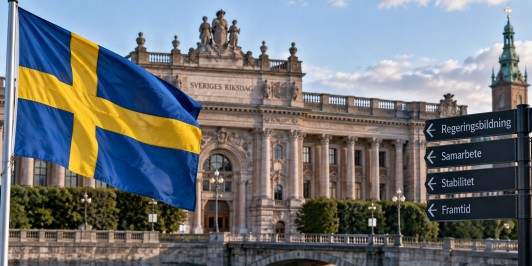
Sweden finds itself in a complex political situation as coalition talks commence after a tightly contested parliamentary election. With nearly all votes tallied, the centre-left bloc, spearheaded by the Social Democrats, has secured a slight advantage over the right-leaning parties, obtaining 176 seats in parliament compared to the 173 seats garnered by the latter. As the final count, which includes overseas votes, is awaited later this week, both political sides are actively engaged in negotiations to form the next government.
Magdalena Andersson, the leader of the Social Democrats, is at the forefront of discussions aimed at establishing potential coalition partnerships in her bid to reclaim governmental leadership. Concurrently, outgoing Prime Minister Ulf Kristersson and his centre-right affiliates are assessing opportunities to maintain their hold on power. This razor-thin margin has led to uncertainty regarding the future government’s makeup, with the Centre Party expected to play a pivotal role in these negotiations. However, there is contention over the possibility of collaboration with the Left Party, as the Centre Party insists on a stable government with a clear centre-right orientation and has dismissed cooperation with groups it deems as fringe political entities.
On the left, several parties have shown enthusiasm for a governmental shift while cautioning against a prolonged political stalemate, which could potentially trigger another round of elections. Despite previously supporting the outgoing right-wing government, the Sweden Democrats have seen a drop in their backing, making their participation in the new government unlikely. Nevertheless, their influence remains evident, as their stances on issues such as immigration, integration, and crime have permeated mainstream political discourse.
Kristersson is keeping his options open as he waits for the final election outcome. The Moderates, along with their allies, face the considerable challenge of securing a viable parliamentary majority. Meanwhile, the Liberals and Christian Democrats have expressed a firm stance against collaborating with the Social Democrats. The new parliament is set to convene on September 28, with the earliest potential vote for a prime minister occurring the subsequent day. In the event that repeated attempts to elect a prime minister are unsuccessful, Sweden might have to prepare for another election cycle.
Coalition discussions could extend over several weeks or months. Historical precedents include the 37 days required to form a government after the 2022 election and the 134 days of negotiations following the 2018 election. With no single political bloc holding a definitive majority, the roles of the Centre and Left parties are crucial in determining the composition of Sweden’s next government.