
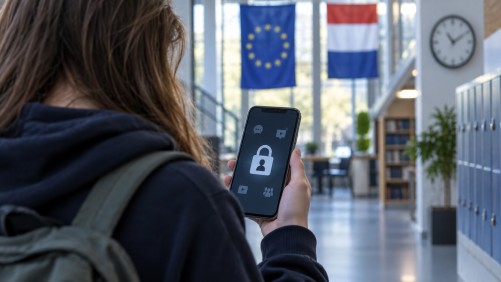
As European nations grapple with the challenge of safeguarding children online, the Dutch government has thrown its support behind a proposal for a European Union-wide minimum age regulation for social media use. This initiative aims to create a unified framework across EU member states to enhance online safety for minors.
The Netherlands, in collaboration with Spain, has put forward a proposal to the European Commission advocating for a standard minimum age for accessing social media platforms. This proposal includes the implementation of privacy-focused age verification measures to ensure compliance. Specifically, the Dutch coalition government is championing a minimum age of 15 for social media participation, a stance articulated by Digital Economy Minister Willemijn Aerdts, who emphasized the need for consistent safety standards both online and offline.
This move comes as part of broader digital policy discussions by the European Commission, which is expected to present comprehensive proposals on protecting children from the risks associated with social media. The push for unified regulations is gaining momentum as various countries have independently introduced age restrictions. Notably, Australia imposed a ban on social media use for individuals under 16 starting December 2025, while France recently set a minimum age of 15. The United Kingdom has also announced plans to implement similar restrictions for those under 16 by 2027.
While the proposal has been met with support, it also raises concerns among privacy advocates regarding the implementation of age verification systems. The European Commission previously introduced an age-checking app in April, which was quickly found to have vulnerabilities by a security researcher, necessitating a security update. This incident highlights the ongoing challenge of balancing effective age verification with the protection of personal data.