
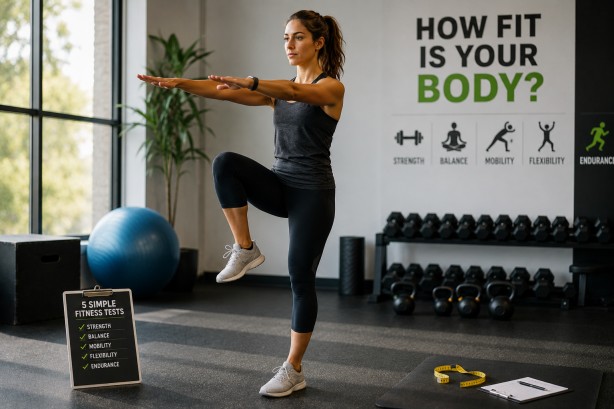
Fitness encompasses more than just the ability to lift weights or run marathons. It includes the capacity to perform routine tasks like squatting, rising from the floor, and maintaining balance, which can offer valuable insights into one’s functional fitness. To assess various aspects of physical ability, such as strength, flexibility, mobility, grip, and balance, five straightforward movements can be employed. These exercises require minimal equipment and can generally be done at home, as long as they are executed safely.
The deep squat hold is one such exercise. By standing with feet hip-width apart and lowering into a deep squat while keeping heels grounded, individuals can test their ankle, knee, and hip mobility, along with lower-body strength and control. Maintaining this posture for up to 60 seconds without support can indicate lower-body control proficiency. If holding the position is difficult or if heels lift from the floor, it may suggest a need for improvement in mobility or control.
Another exercise, the dead hang, involves hanging from a secure pull-up bar with extended arms. A 30-second hold can reveal grip strength and upper-body endurance, while also requiring shoulder stability and control. Those new to this should ensure the bar is securely fixed and avoid it if there are any injuries that could worsen from hanging. The task of getting up from the floor without using hands, knees, or forearms also evaluates lower-body strength, balance, coordination, and mobility. Although difficulty in performing this movement may highlight areas for improvement, it’s important to consider that performance can vary greatly based on factors like age, flexibility, previous injuries, and fitness level.
The forward fold is another key movement. By standing with feet hip-width apart and bending forward with straight legs, individuals can test flexibility in the hamstrings and other posterior muscles. Not reaching the floor is not necessarily indicative of poor health, as flexibility varies among individuals and can be improved through consistent stretching and mobility exercises. The single-leg balance exercise, where one stands on one leg and attempts to maintain balance, engages muscles, joints, and the nervous system to uphold stability. For an increased challenge, closing the eyes for a short time can be attempted, though this should be done in a clear area with a stable surface nearby for safety.
Collectively, these exercises offer a simple overview of various functional fitness components, encouraging individuals to consider their strength, mobility, flexibility, grip, coordination, and balance. They are not designed as medical or diagnostic tools, and there is no standardized score for everyone to achieve. Factors such as age, training experience, injuries, and individual body structure can affect performance. The aim is not to immediately excel in each test but to use them to identify areas needing improvement and to work on them gradually with safe and consistent exercise.