
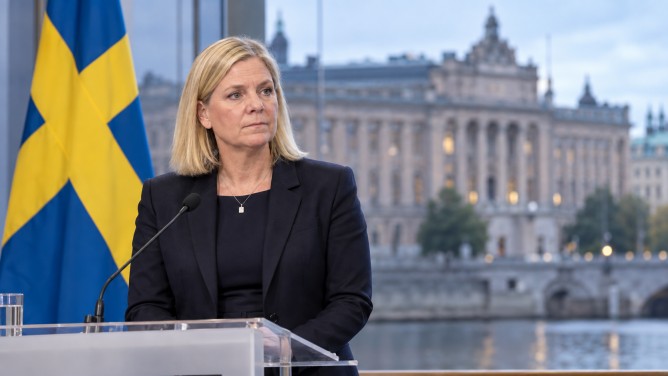
Sweden’s political landscape has hit a roadblock as Social Democratic leader Magdalena Andersson has halted her efforts to form a new government. Andersson announced her decision following a shift in parliamentary dynamics, primarily triggered by the Left Party’s recent decision to back the Moderate Party’s candidate for Speaker of the Riksdag. This move, she stated, has altered the political situation and the conditions needed for her to assume the role of prime minister.
The Left Party’s support for the Moderate candidate is based on their belief that the current Speaker’s experience would be beneficial in the government-formation process. Despite this, the Left Party maintains that Andersson remains their preferred choice for prime minister, although they have also expressed a desire to be part of future government negotiations. This has led to tensions, as the Left Party voiced concerns over being sidelined in discussions involving the Social Democrats, Greens, and Centre Party.
Andersson is expected to return the task of forming a government to the newly elected Speaker. The responsibility may then fall to Ulf Kristersson, leader of the Moderate Party, Nooshi Dadgostar of the Left Party, or another party leader aligned with the current parliamentary configuration. Andersson has not ruled out the possibility of making another bid for prime minister should the conditions become favorable in the future.
The interconnected nature of the Speaker election and the government-formation process has been a significant factor in Andersson’s decision. The Left Party, while dismissing any formal cooperation with the Moderates, emphasizes the importance of experience during this critical political juncture.
Andersson’s withdrawal from the current government-formation attempt highlights the complexities of Sweden’s political environment, where party alliances and strategic decisions play crucial roles in shaping the country’s leadership. As the situation continues to evolve, the potential for new leadership to emerge remains a possibility.